
F-500 FIRE EXTINGUISHERS & FIRE BLANKET
FOR LITHIUM-ION BATTERY FIRES
Proven to Cool, Contain, and Stop Thermal Runaway in Lithium-Ion Batteries
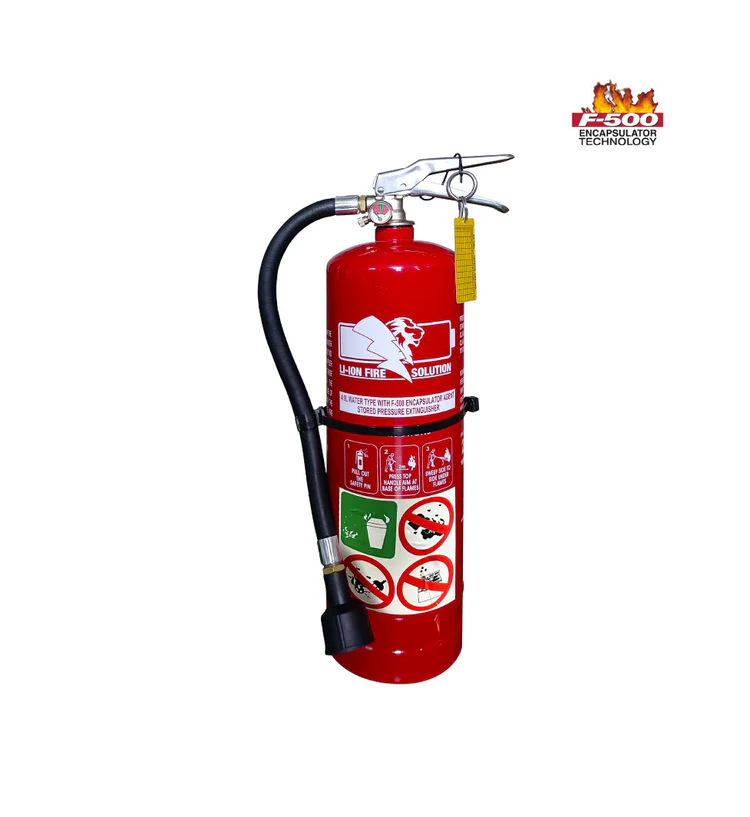
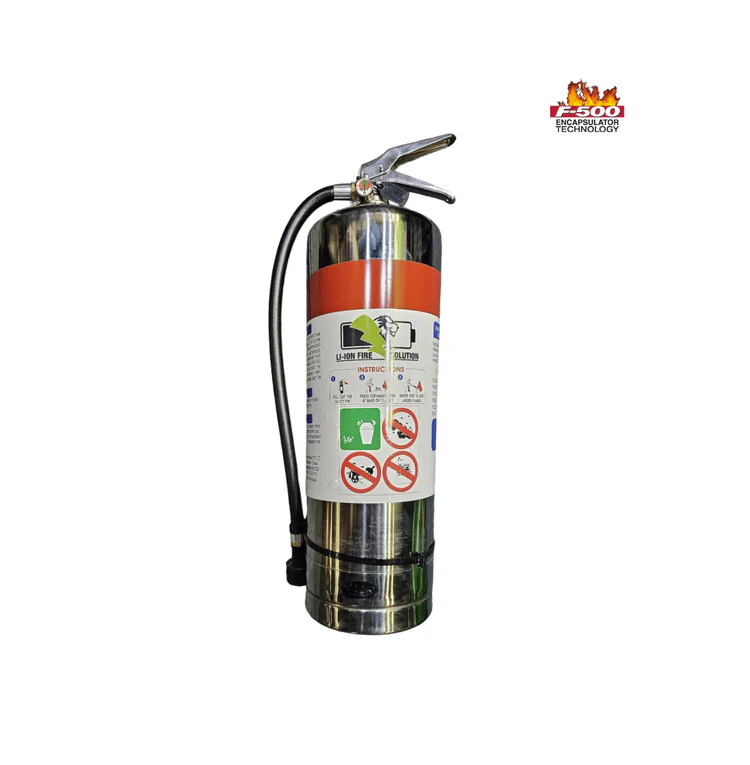
Protect your workplace, EV workshop, or home with the F-500 Lithium-Ion Battery Fire Extinguisher. This is the first water-based agent proven to extinguish lithium-ion battery fires and prevent dangerous reignition—a critical feature standard extinguishers lack.
All our F-500 extinguishers are manufactured and tested to comply with Australian Standard AS/NZS 1841.2 and AS 1850 for Class A, B, and F fires, giving you confidence in their performance and safety.
Why Choose the F-500 for Lithium-Ion Battery Protection?
Our 4L and 9L units have been independently tested on 2.4kWh and 4.8kWh Li-ion battery fires, demonstrating exceptional cooling and suppression capabilities.
-
Stops Thermal Runaway: The unique Encapsulator agent rapidly cools battery cells, breaking the chain reaction that causes fires to spread.
-
Prevents Reignition: Unlike powder or CO2 extinguishers, the F-500 cools the battery core, dramatically reducing the risk of re-ignition hours or days later.
-
Safe for Sensitive Equipment: As a water-based agent, it is non-toxic and leaves minimal residue, making it safe for use near electronics and EV charging stations.
Choose Your F-500 Extinguisher
ModelCapacityTested OnBest ForPrice
F-500 4 Litre 4L2.4kWh Li-ion Battery - E-bikes, small battery storage, home workshops
F-500 9 Litre 9L4.8kWh Li-ion Battery - EV workshops, warehouse charging bays, solar storage
Quick Specs & Compliance
-
Standard: AS/NZS 1841.2 & AS 1850 (Class A, B, F)
-
Agent: F-500 Encapsulator (Water-based additive)
-
Operating Temperature: +5°C to +60°C
-
Rechargeable: Yes, by certified service centres


F-500 Lithium Battery Extinguisher: FAQs for Buyers
1. Is this extinguisher compliant with Australian Standards?
Yes. Our F-500 extinguishers are fully manufactured and tested to meet the requirements of AS/NZS 1841.2 for water-type extinguishers, which is the current recognized standard for this technology.
2. Is this better than an ABE dry powder extinguisher for battery fires?
Yes. ABE powder can be corrosive, creates a visibility hazard, and does little to cool the battery, meaning reignition is highly likely. The F-500 cools the cells to stop the fire at its source.
3. Where should I install this extinguisher?
Install it within 10-15 metres of your battery charging stations, EV service bays, battery storage rooms, or anywhere lithium-ion batteries are used or stored. Ensure it is clearly visible and accessible.
4. Can this extinguisher be serviced?
Absolutely. Like all fire extinguishers, the F-500 requires regular servicing as per AS 1850. We can connect you with a network of local service providers.
5. Does it work on other fire types?
Yes. The F-500 is rated for Class A (wood, paper), Class B (flammable liquids), and Class F (cooking oils & fats), making it a versatile addition to your safety equipment.
6. Is the F-500 better than a CO2 extinguisher for lithium-ion battery fires?
Yes, for battery fires specifically. CO2 extinguishers work by displacing oxygen and cooling the surface of a fire, which can knock down visible flames — but they don't cool the battery cells themselves. Lithium-ion fires are driven by thermal runaway inside the cell, so once you stop discharging CO2, the battery can reignite minutes or even hours later. The F-500's Encapsulator agent penetrates and cools the cells directly, addressing the root cause of thermal runaway rather than just the visible flame — which is why it's specifically tested and rated for this application while CO2 is not.
This one is worth having because "CO2 vs F-500" (or "CO2 vs lithium battery fire") is a genuine comparison search, and right now competitors who address it directly have an edge on that query.
Ready to Secure Your Site Against Battery Fires?
Don't wait for a thermal runaway event. Equip your team and facility with the proven protection of an F-500 extinguisher.
Select your model above and click "Add to Cart" for immediate shipping. For bulk orders or for advice on a complete fire safety plan, click "Request a Quote."


Get more for less